
 English
 Views: 0 Author: Site Editor Publish Time: 2026-08-17 Origin: Site


An aluminum pool fence is a visible part of a pool landscape, but its primary role is safety. It helps create a controlled barrier between the water area and the rest of the property, reduces unauthorized access, and supports safer day-to-day use. The right pool fence is not defined only by its color or style. Fence height, gate action, panel spacing, hardware, corrosion resistance, installation, and local rules all need careful review. This guide explains the key decisions behind a metal pool fence system for residential, hospitality, community, and commercial pool projects.
Pool fencing requirements vary by jurisdiction, so local regulations must be confirmed before ordering materials.
Aluminum is commonly used near pools because it is lightweight and corrosion resistant.
A pool barrier must be assessed as a complete system, including gates, latches, hinges, posts, panels, and gaps.
Black aluminum pool fence designs can provide a clean appearance and preserve views across landscaped pool areas.
Regular inspection of gates, hardware, coating condition, and surrounding landscaping is essential for safety.
A pool fence is not simply a boundary around water. It is a safety barrier designed to help restrict unsupervised entry. The fence, gate, latch, hinges, post foundations, panel geometry, and nearby landscaping must work together.
An attractive installation can still be unsafe if a gate does not latch, a panel has an excessive gap, a post becomes loose, or nearby furniture creates an unintended climb point. Safety therefore starts with planning and continues through installation, handover, maintenance, and daily use.
For every project, verify the applicable local code or safety standard. Requirements vary by country, state, municipality, building type, pool type, and whether the project is residential or commercial. Do not use a generic online height or gap recommendation as a substitute for local compliance review.
The project team should establish who is responsible for confirming the required barrier details before fabrication begins. This is particularly important for exported products and projects in multiple jurisdictions.
An aluminum pool fence is often selected because aluminum is corrosion resistant, relatively lightweight, and available in open styles that preserve sightlines. In a pool environment, visibility can be valuable for supervision and for maintaining the visual openness of the landscape.
Aluminum can be used for panels, posts, gates, and selected accessories. Its suitability still depends on the alloy, profile design, coating, hardware compatibility, installation method, and environmental exposure. A coastal property, for example, may require a more careful review of corrosion risks than an inland garden.
The following comparison shows why buyers often consider aluminum:
Consideration | Aluminum pool fence | Steel fence system |
|---|---|---|
Weight | Generally lighter | Generally heavier |
Corrosion resistance | Naturally resistant, finish still matters | Requires suitable galvanizing or coating |
Appearance | Clean, open, adaptable styles | Can support more robust security-oriented styles |
Typical use | Residential, community, hospitality pools | Higher-impact or non-pool perimeter applications |
Maintenance focus | Hardware, coating, gates, panel alignment | Coating condition, corrosion prevention, gates |
A metal fence around a pool should always be specified for the water-adjacent environment. Chlorinated air, frequent humidity, cleaning agents, splash zones, and coastal conditions can affect different materials and finishes in different ways.
A black aluminum pool fence is widely used because dark finishes can blend into the background, allowing the landscape, water, and architecture to remain visually prominent. Black also works with contemporary, traditional, tropical, and minimalist outdoor designs.
An open black fence can maintain views from a patio, outdoor kitchen, or living room while creating a clear separation around the pool. This is particularly useful when the pool area needs a barrier but the project does not want a solid wall.
When choosing a black finish, consider how it will appear in full sun, against pale paving, beside dark window frames, and behind planting. A consistent finish across panels, posts, gates, connectors, and caps creates a more professional result.
However, style should not override functionality. Avoid using large planters, benches, storage boxes, or decorative structures against the outside of a pool barrier if they could create a climbable route. Design landscaping to complement the fence without reducing its safety function.
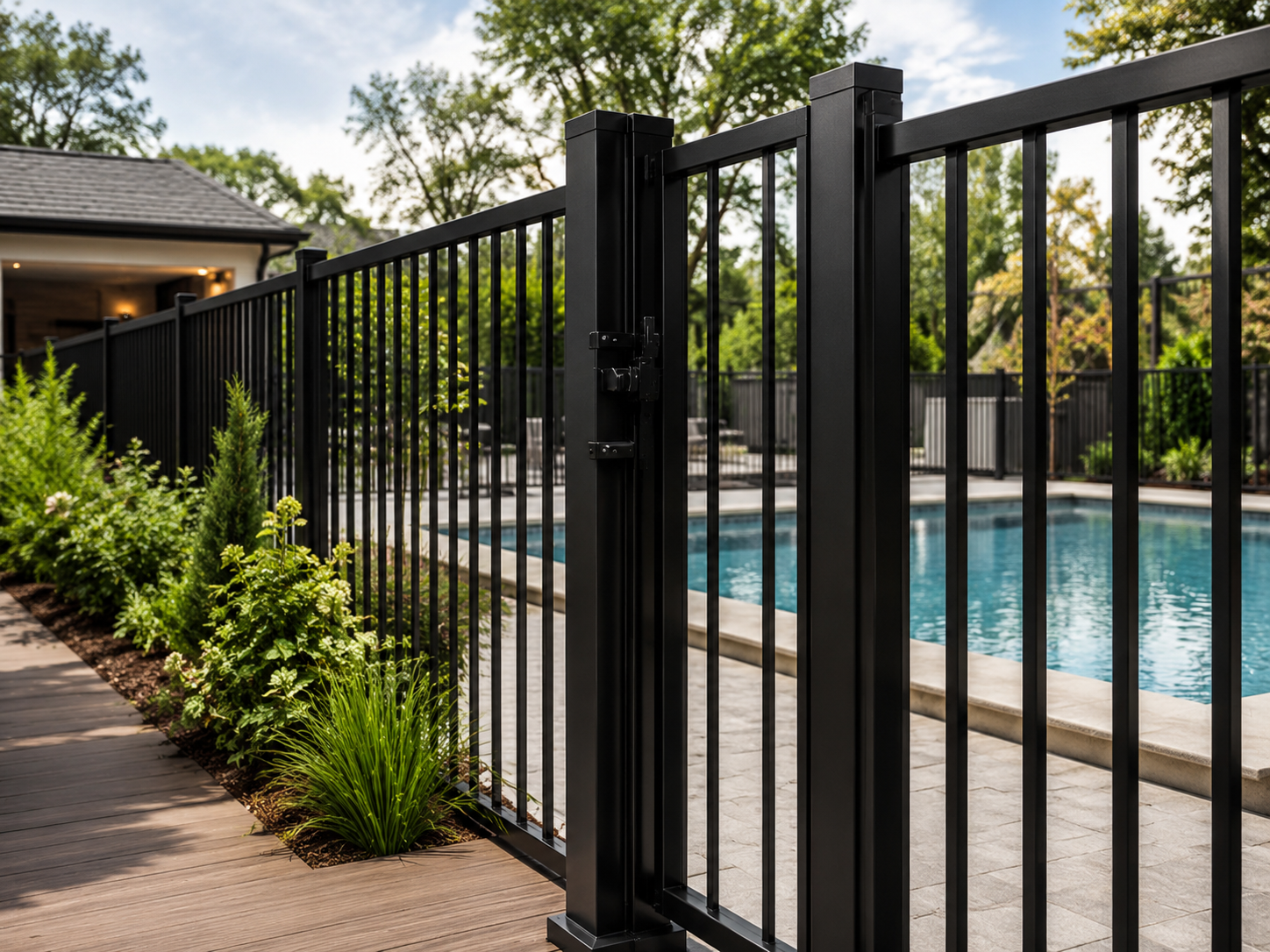
A pool safety fence metal system is only effective when the gate closes and latches reliably. Gates are used frequently, and they are the part of the barrier most likely to be left open, misaligned, or affected by settling.
The gate must be designed for the local safety rule. In many markets, pool gates are required to self-close and self-latch, but the exact requirements vary. Confirm the direction of swing, latch height, hinge type, clearances, and emergency access provisions before finalizing the system.
A pool gate should be easy for authorized adults to use but should not create a simple access point for children. It also needs enough room to operate without striking furniture, planting, pool equipment, or a wall.
For a coordinated installation, the gate frame, panel profile, posts, and finish should be specified together. A compatible aluminum fence connector for pool enclosures can support stable rail-to-post connections when it is selected for the relevant aluminum profile and project conditions.
The fence line should be planned around how people will actually use the property. Consider the route from the home to the pool, pool equipment access, emergency access, outdoor dining areas, and maintenance paths.
A barrier placed too close to the water may make cleaning and servicing difficult. A barrier placed too far away may create a large enclosed zone that is harder to supervise. The suitable location depends on local rules, site size, pool layout, and the intended use of the space.
Avoid placing permanent features against the fence. Trees, planter walls, outdoor furniture, grills, storage items, and decorative structures can alter the barrier’s safety performance. Landscaping should be maintained so the lower part of the fence remains visible and accessible for inspection.
If the pool area is within a larger garden, coordinate the pool barrier with the surrounding metal garden fence. The systems do not need to be identical, but they should look compatible while clearly distinguishing the safety-critical pool zone from the rest of the property.
Pool environments can be demanding for metal components. Humidity, treated water, cleaning products, and local climate all affect the long-term condition of the fence.
Aluminum is a practical material for many pool fence applications, but fittings and fasteners must also be considered. Dissimilar metals can create corrosion issues in some conditions. Use accessories and fasteners that are suitable for the selected aluminum system and the intended exposure.
Powder-coated finishes can support appearance and help protect the surface. During installation, avoid unnecessary drilling, cutting, or abrasion after the components have been finished. If on-site modifications are unavoidable, follow the supplier’s recommended touch-up process.
Inspect lower rails, post bases, connectors, gate hardware, and areas exposed to splash or irrigation. These are often the locations where problems first become visible.
A pool fence should be included in the property’s regular safety and maintenance routine. This is especially important before a busy swimming season, after storms, after landscaping work, or after changes to outdoor furniture.
Inspect the gate first. Confirm that it closes fully, latches as intended, and is not obstructed. Check hinges, fasteners, posts, and panel connections. Look for scratches, loose fittings, signs of movement, or buildup of debris around post bases.
Wash the fence with water and a mild cleaner appropriate for the finish. Avoid harsh cleaning methods that may damage coated surfaces. Keep vegetation trimmed so it does not pull on the panel or hide a problem.
For general component selection, Cangzhou Weijiang Metal Products Co., Ltd. offers metal fence accessories in multiple materials and finishes. Buyers should still confirm compatibility with their pool-fence profile, local code, and corrosion exposure.
The most common issues are usually planning or maintenance problems rather than material failure. Avoid specifying an ordinary decorative fence without checking pool regulations. Do not assume that a high fence is automatically compliant. Do not use a gate design that has not been evaluated for the required latching and closing action.
Avoid creating a climbable condition around the barrier. A well-designed fence can lose much of its safety value if furniture, planters, trees, or storage items are placed against it. Also avoid neglecting a gate that begins to sag or fail to latch; this should be corrected promptly.
Finally, do not treat a pool fence as a substitute for adult supervision, safe operating rules, pool covers, alarms, or other safety measures that may be appropriate for the property.
An aluminum pool fence can combine safety, corrosion resistance, and clean landscape design when it is specified and maintained as a complete barrier system. The choice of black finish, aluminum fence panels, connectors, posts, gates, and landscaping should support the safety function rather than compromise it.
Confirm local requirements early, plan the gate carefully, select compatible hardware, and inspect the barrier regularly. With a site-specific approach, Weijiang Metal can support fence-component sourcing for pool enclosure projects that require coordinated materials, finishes, and custom hardware considerations.
Aluminum is commonly used for pool fencing because it is lightweight and corrosion resistant. The specific panel, gate, hardware, finish, and installation must still suit the local safety requirement and site environment.
Black is popular because it can blend into the landscape and preserve views. The best color depends on the project’s architecture, paving, planting, maintenance preferences, and finish availability.
Requirements vary by location and project type. Many jurisdictions require self-closing and self-latching pool gates, but the project team must verify the applicable local rule before selecting a gate.
Not automatically. A standard garden fence may not meet the required height, opening, gate, latch, or barrier-performance criteria for a pool area. Confirm local pool barrier regulations first.
Check the gate regularly, including before periods of frequent pool use and after storms, impacts, or landscaping work. Test its closing and latching action and correct any issue promptly.
Clean the fence with mild products suitable for the finish, inspect for scratches or loose hardware, keep vegetation clear, and check the gate, hinges, latch, and post alignment routinely.


