
 English
 Views: 0 Author: Site Editor Publish Time: 2026-08-07 Origin: Site


The true cost of a fence extends far beyond initial materials and installation labor. It includes the cumulative hours you spend power washing, sealing, and repairing rot over the next 15 years. Manufacturers frequently market "maintenance-free" options to eager homeowners. However, the reality is every material requires some baseline upkeep. Your primary goal should involve minimizing high-effort maintenance. You want to avoid constant sanding, staining, or replacing warped boards. Instead, you should aim for low-effort upkeep like simple annual hose-downs.
This guide breaks down the most reliable low-maintenance fencing materials available today. We explore why a properly treated metal fence frequently provides superior resilience and overall value. You will discover exactly how local climate conditions impact material lifespan. Ultimately, we will help you evaluate aesthetic goals and confidently shortlist the right structural solution for your property.
Understanding what constitutes a low-maintenance fence helps you avoid marketing traps. Many products promise effortless ownership. You must evaluate them against strict structural criteria before making a decision.
A true low-maintenance material must inherently resist environmental decay. It should reject rot and insect damage naturally. It must withstand UV degradation without fading or becoming brittle. Furthermore, the material should resist warping or sagging under its own weight. It must achieve all this without requiring applied chemical treatments or sealants.
Evaluating fences requires comparing the required effort against the frequency of tasks. We categorise maintenance into distinct levels to clarify ownership expectations.
| Maintenance Level | Required Actions & Frequency | Typical Material Profile |
|---|---|---|
| High Effort | Annual sanding, bi-annual staining, frequent painting, replacing split or rotted support posts. | Traditional Cedar, Pine, or Spruce Wood |
| Low Effort | Gentle annual power washing, seasonal hinge tightening, occasional touch-ups for accidental scratches. | Vinyl, Composite, Treated Metal |
The definition of low maintenance varies significantly by geographical region. Coastal environments introduce heavy salt air. Salt accelerates corrosion on untreated metals rapidly. Northern climates bring heavy snow loads and deep freeze-thaw cycles. These extreme temperature shifts expose weaknesses in cheaper vinyl plastics. High UV indexes in southern regions cause rapid color fading. You must align your material choice with your specific local weather patterns.
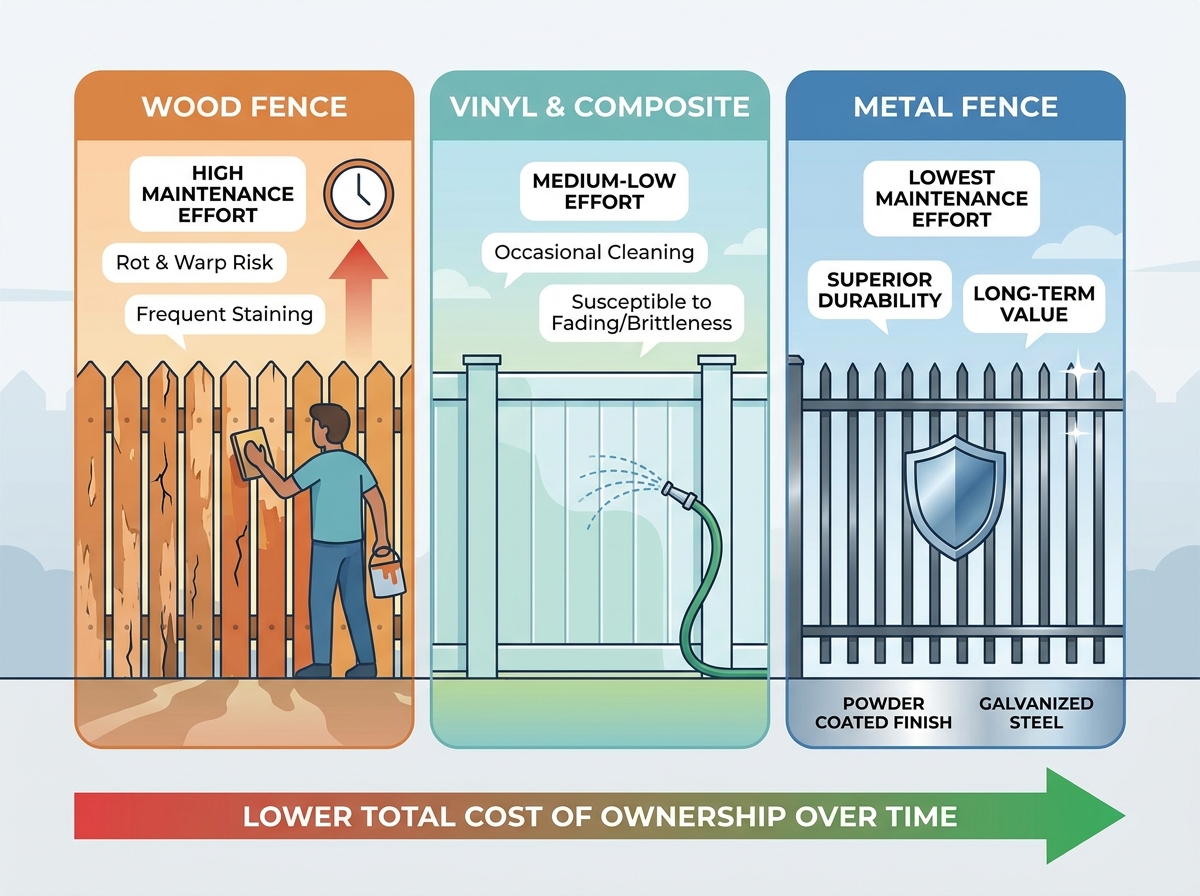
The market primarily offers three distinct categories for low-maintenance barriers. Each material presents unique advantages and inherent compromises.
Vinyl fencing remains a dominant choice for residential properties seeking immediate privacy.
Composite materials blend recycled wood fibers with dense plastic polymers.
When longevity dictates your choice, metal often emerges as the superior option. It offers the highest strength-to-weight ratio available in residential fencing. Properly installed metal posts do not warp, sag, or snap under extreme wind pressure. It frequently outlasts both vinyl and composite alternatives. This durability makes it the most resilient choice for security. It provides unmatched lifecycle value when properly finished.
Selecting metal requires understanding different base elements and protective finishes. You must match the exact alloy and coating to your property needs.
An aluminum fence serves as an exceptionally versatile residential option. It works perfectly for general property borders and pool enclosures. It handles sloped yards effortlessly because contractors can easily rack the panels. Aluminum remains naturally rust-proof throughout its lifespan. It is remarkably lightweight for easy installation. However, the softer metal can dent under heavy impact from falling branches.
A galvanized steel fence provides exceptional strength for high-security applications. Manufacturers coat the raw steel core in a protective zinc layer. This vital layer prevents destructive rust formation. Galvanized steel proves much stronger than standard aluminum. It resists heavy blunt impacts beautifully. You must remain vigilant, however. Deep scratches piercing the zinc layer require prompt touch-up paint to prevent localized corrosion.
Surface treatments completely change metal performance. A powder coated fence utilizes an advanced finishing technology. Manufacturers bake dry powder directly onto the metal surface under extreme heat. This process creates a shell far thicker and more durable than traditional liquid paint. Always look for multi-layer treatments when evaluating products. A galvanized base paired with a powder-coated top layer delivers maximum defense against the elements.
A stainless steel fence represents the absolute pinnacle of corrosion resistance. It contains chromium, which naturally repairs microscopic surface scratches. This material excels in extreme coastal environments. It also suits high-end modern architectural projects. The reality, however, involves substantial expense. Stainless steel remains generally cost-prohibitive for standard residential perimeter applications.
A corrugated metal fence offers a unique blend of high privacy and low-budget durability. It delivers a modern industrial aesthetic that stands out. The solid sheets are highly opaque. They deflect harsh winds and street noise exceptionally well. You must ensure proper installation techniques, though. Installers must properly frame all sharp sheet edges. This framing prevents physical injury and stops premature edge rust.
Your specific need for seclusion or openness directly dictates your material options. You must define your primary functional goal before purchasing.
Many homeowners prefer open sightlines to monitor children or preserve scenic views. Pre-fabricated metal fence panels provide the perfect solution here. They feature evenly spaced aluminum or steel pickets. These panels offer remarkably fast installation times. They establish highly secure boundaries for pets and pool areas. More importantly, they require virtually zero aesthetic maintenance over the years.
Traditional open metal pickets fail when you need complete backyard seclusion. You must explore alternative low-maintenance solutions for privacy.
Evaluating fencing requires looking past the initial installation day. You must consider how materials physically perform over a 15-year timeline. Ignoring structural risks leads to frustrating weekend repair projects.
Wood often seems appealing initially due to straightforward installation. However, it demands constant physical attention by year five. High-grade metal and premium vinyl demand more precise initial handling. Yet, they require almost zero weekend labor annually to maintain. You trade a slightly more complex installation phase for decades of structural peace of mind.
Even the finest materials fail if installed poorly. You must monitor specific installation practices.
You should always read the fine print on manufacturer warranties. Many companies advertise impressive "lifetime" coverage. These warranties often contain strict exclusionary clauses. They frequently exclude properties located near coastal saltwater. Some even require documented proof of specific annual cleaning routines. Failing to follow these hidden rules voids your structural protection completely.
Choosing the right barrier involves balancing practical needs with environmental realities. Use a structured approach to narrow down your options.
Review your primary property goals to select the best match.
Moving forward requires specific preparatory actions. First, check your local Homeowner Association (HOA) guidelines immediately. Many strict HOAs restrict specific materials or mandate certain colors. Second, request official property line utility markings by dialing 811. Hitting an underground utility line causes disastrous delays. Finally, source two to three professional quotes. Demand that contractors specify precise material grades, such as the exact wall thickness of the metal tubing.
Escaping endless weekend fence maintenance requires proactive planning. You must choose materials specifically engineered for your regional climate and structural demands. We have explored how distinct finishes protect your investment against the elements. We also examined how hybrid designs balance rugged durability with backyard seclusion.
While no exterior structure is entirely "set it and forget it," making an informed upgrade transforms your ownership experience. Transitioning to a properly coated metal, dense composite, or high-grade vinyl system yields massive benefits. It successfully shifts your maintenance burden from complex structural repairs to a quick, painless annual wash.
Take the next practical step toward securing your property. We encourage you to request physical material samples from manufacturers. Alternatively, schedule a comprehensive site evaluation with a certified local installer today.
A: Bare steel rusts quickly when exposed to moisture. However, modern fencing utilizes protective barriers. Galvanized steel uses a zinc coating to block rust. Aluminum naturally resists rust completely. Adding a baked-on powder coating over these metals provides exceptional, long-lasting rust defense, provided you quickly touch up deep scratches.
A: Aluminum generally offers superior long-term durability. Vinyl provides excellent privacy but can become brittle in freezing temperatures or warp under high heat. It also acts like a sail in heavy winds. Aluminum easily withstands extreme temperature fluctuations and high winds without sagging, cracking, or degrading over a 20-year span.
A: Metal picket panels are exceptional for dogs. They are entirely chew-resistant and withstand jumping impacts without denting. They also allow dogs to see through, reducing boundary frustration. If your dog is highly reactive to visual stimuli, a solid low-maintenance vinyl or hybrid composite fence is better for blocking sightlines.
A: Cleaning requires minimal effort. Manufacturers recommend washing the surface annually using warm water, mild non-abrasive dish soap, and a soft-bristle brush. Gently scrub away dirt or bird droppings, then rinse thoroughly with a standard garden hose. You must avoid harsh chemical solvents or abrasive scrubbers, which damage the coating.


